
SAMPLE LETTER
Two characters for “woman,” from a townsman’s notebook
Our post on blackened teeth and shaved brows (No. 11 on Instagram and TikTok) showed a few lines from Kitagawa Morisada’s notebook. Here is the whole passage: how a woman’s hair, teeth and eyebrows marked her as married or not, and how the custom differed between Kyoto, Osaka and Edo (today’s Tokyo).
Morisada, an Osaka-born townsman who settled in Edo in 1840, wrote these notebooks between 1837 and 1867. They are kept at the National Diet Library of Japan.
I. Girls’ hair, wives’ hair
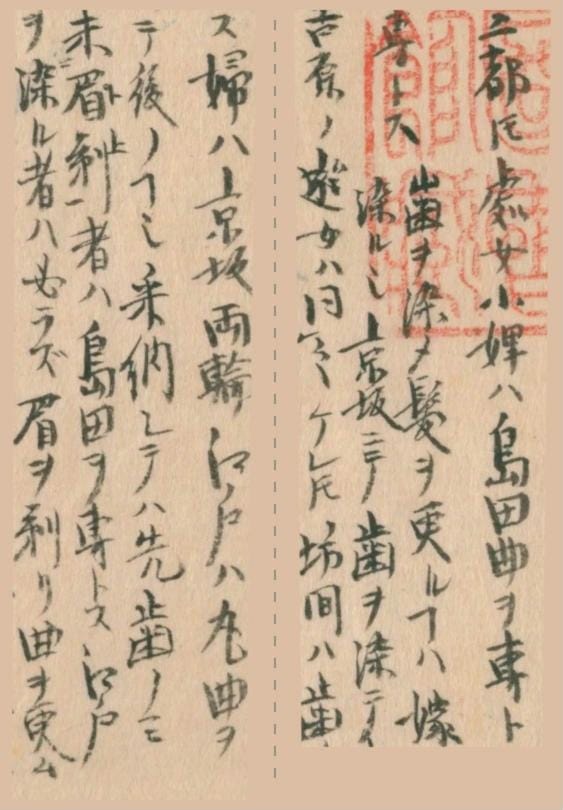
三都トモ處女小婢ハ島田曲ヲ専トス 婦ハ京坂両輪 江戸ハ丸曲ヲ専トス 歯ヲ染メ髪ヲ更ルコトハ嫁テ後ノコト也 采納シテハ先歯ノミヲ染ル也 京坂ニテ歯ヲ染テ未剃眉者ハ島田ヲ専トス 江戸吉原ノ遊女ハ同ジケレトモ 坊間ハ歯ヲ染ル者ハ必ラズ眉ヲ剃リ曲ヲ更ム
In all three cities, unmarried girls and young maidservants mostly wear their hair in the shimada style. Wives mostly wear the ryōwa [“double ring”] in Kyoto and Osaka, and the marumage [“round bun”] in Edo. Blackening the teeth and changing the hair come after the wedding. Once the betrothal gifts have been exchanged, a woman first blackens only her teeth. In Kyoto and Osaka, women with blackened teeth but unshaved brows mostly keep the shimada. So do the courtesans of Edo’s Yoshiwara. But in the town at large, a woman who blackens her teeth always shaves her brows and changes her hair.
- The three cities are Kyoto, Osaka and Edo.
- The character we read as “dye” (染), here and in the next two sections, is written in a form that could also be taken as 漆, “lacquer.” The printed edition of 1908 reads 染. Either way, the sense is blackening the teeth.
- In the third line, the manuscript writes 未眉剃 with a reading mark; we give the characters in reading order.
II. “Half coming-of-age”
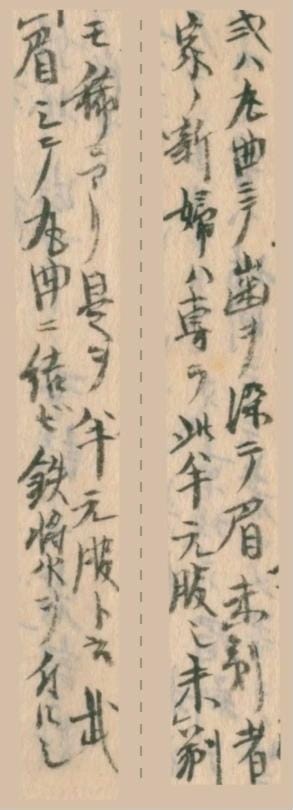
或ハ丸曲ニテ歯ヲ染テ眉未剃者モ稀ニアリ 是ヲ半元服ト云 武家ノ新婦ハ専ラ此半元服也 未剃眉ニテ丸曲ニ結ビ鉄漿ヲ付ル也
In rare cases you also see a woman in a marumage with blackened teeth whose brows are not yet shaved. This is called han-genpuku, “half coming-of-age.” New brides in samurai households mostly wear it this way: brows unshaved, hair tied in a marumage, teeth blackened with kane.
- Genpuku is the coming-of-age ceremony. Kane is the black dye for the teeth, also called ohaguro.
Read the rest: 5 more passages and 5 original pagesHide the rest
III. What Kyoto, Osaka and Edo call it
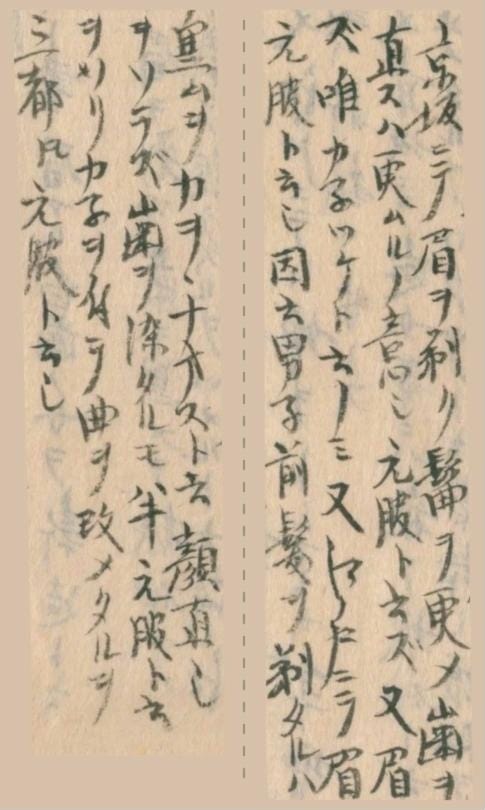
京坂ニテ眉ヲ剃リ髷ヲ更メ歯ヲ黒ムヲカヲヽナホスト云 顔直也 直スハ更ムルノ意也 元服ト云ズ 又眉ヲソラズ歯ヲ染タルモ半元服ト云ズ 唯カネツケト云ノミ 又江戸ニテ眉ヲソリカネヲ付テ曲ヲ改メタルヲ元服ト云也 因云 男子前髪ヲ剃タルハ三都トモ元服ト云也
In Kyoto and Osaka, shaving the brows, changing the hair and blackening the teeth is called kao o naosu, written 顔直, “redoing the face”; naosu here means to change. They do not call it genpuku. Nor do they call blackened teeth with unshaved brows han-genpuku; they simply call it kanetsuke, “putting on the dye.” In Edo, shaving the brows, putting on the dye and changing the hair is called genpuku. A side note: when a boy has his forelock shaved, all three cities call it genpuku.
IV. On checkpoint passes
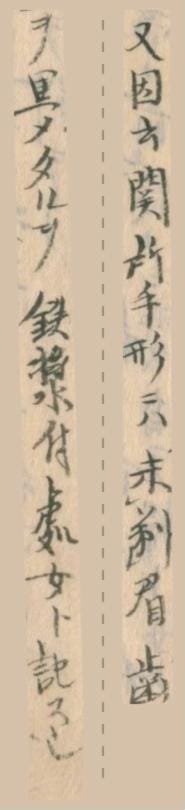
又因云 関所手形ニハ未剃眉歯ヲ黒メタルヲ鉄漿付處女ト記ス也
Another note: on checkpoint passes, a woman with unshaved brows and blackened teeth is written down as 鉄漿付處女, “a maiden with dyed teeth.”
V. Pregnancy, age, and the two regions
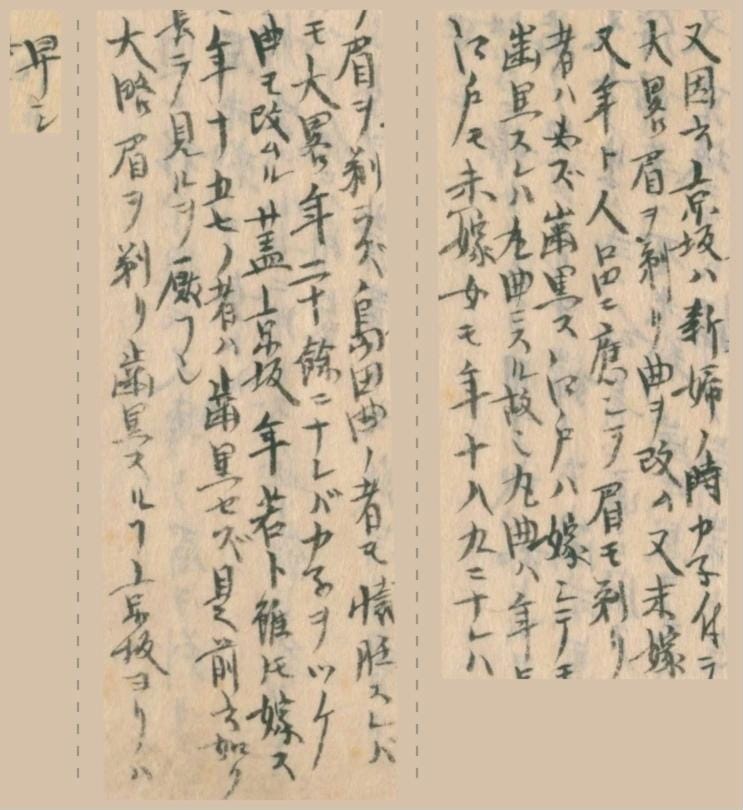
又因云 京坂ハ新婦ノ時カネ付テ眉ヲ剃ラズ島田曲ノ者モ懐胎スレバ大略眉ヲ剃リ曲ヲ改ム 又未嫁モ大略年二十餘ニナレバカネヲツケ 又年ト人品ニ應シテ眉モ剃リ曲モ改ムル 蓋京坂年若ト雖トモ嫁ス者ハ必ズ歯黒ス 江戸ハ嫁シテモ年十五七ノ者ハ歯黒セズ 是前ニ云如ク歯黒スレバ丸曲ニスル故ニ 丸曲ハ年長テ見ルヲ厭フ也 江戸モ未嫁女モ年十八九ニナレバ大略眉ヲ剃リ歯黒スルコト京坂ヨリハ早シ
A further note: in Kyoto and Osaka, a new bride who has dyed her teeth but kept her brows and her shimada will usually shave her brows and change her hair once she is pregnant. Unmarried women, too, mostly put on the dye once they are past twenty, and shave their brows and change their hair as suits their age and bearing. In short, in Kyoto and Osaka a woman who marries always blackens her teeth, however young she is. In Edo, a married woman of fifteen to seventeen does not blacken her teeth. As said above, blackened teeth go with a marumage, and she does not want the marumage to make her look older. In Edo, even unmarried women mostly shave their brows and blacken their teeth once they turn eighteen or nineteen, earlier than in Kyoto and Osaka.
- The manuscript reads “fifteen-seven”; the printed edition of 1908 has the same. We take it as fifteen to seventeen.
VI. Two characters for “woman”
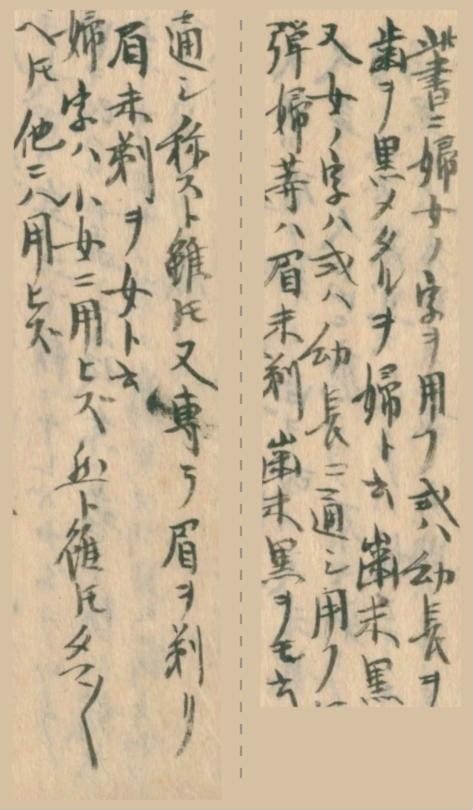
此書ニ婦女ノ字ヲ用フ 或ハ幼長ヲ通シ称スト雖トモ 又専ラ眉ヲ剃リ歯ヲ黒メタルヲ婦ト云 歯未黒眉未剃ヲ女ト云 又女ノ字ハ或ハ幼長ニ通シ用フ 婦字ハ小女ニ用ヒズ 然ト雖トモタマタマ彈〔?〕婦等ハ眉未剃歯未黒ヲモ云ヘトモ 他ニハ用ヒズ
In this book I use the characters 婦 and 女. They are sometimes used for women of any age, but as a rule, a woman who has shaved her brows and blackened her teeth is called 婦, and one whose teeth are not yet black and brows not yet shaved is called 女. The character 女 may be used for young and old alike, but 婦 is not used for young girls. Even so, 婦 is now and then used for 彈婦, women who play the shamisen for a living, even when their brows are unshaved and their teeth white. It is not used for anyone else.
- We take 彈婦, literally “playing women,” to mean geisha. Elsewhere in the same notebook Morisada calls geisha 彈妓, a word built the same way, and the printed edition of 1908 also reads the first character as 彈. The first character is hard to read in the manuscript.
VII. Front sash, back sash
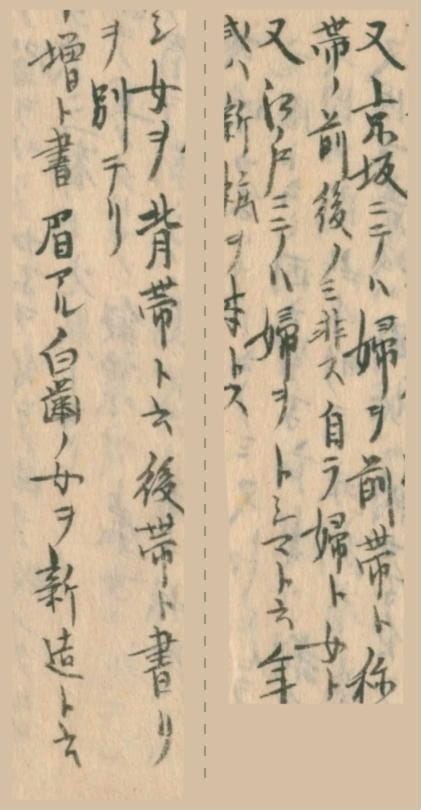
又京坂ニテハ婦ヲ前帯ト称シ 女ヲ背帯ト云 後帯ト書リ 帯ノ前後ノミニ非ズ 自ラ婦ト女トヲ別テリ 又江戸ニテハ婦ヲトシマト云 年増ト書 眉アル白歯ノ女ヲ新造ト云 或ハ新粧ヲ専トス
In Kyoto and Osaka, a 婦 is called “front sash” (前帯), and a 女 “back sash” (背帯, also written 後帯). It is not only a matter of where the sash is tied: the names themselves set 婦 apart from 女. In Edo, a 婦 is called toshima, written 年増, “added years,” and a woman with brows and white teeth is called shinzō (新造), “newly made”; or, more often, it is written 新粧, “newly made up.”
- The last phrase is terse. We read it as saying that the word is more often written 新粧.
Sources
- Kitagawa Morisada, 守貞謾稿 vol. 12, frames 3–4. National Diet Library Digital Collections, pid 2592400 (public domain). dl.ndl.go.jp/pid/2592400
- We checked our reading against the printed edition: 類聚近世風俗志 (1908), vol. 1. National Diet Library Digital Collections, pid 991466. dl.ndl.go.jp/pid/991466
- Morisada’s use of 彈妓 for geisha: 類聚近世風俗志 (1908), vol. 2. National Diet Library Digital Collections, pid 991467. dl.ndl.go.jp/pid/991467
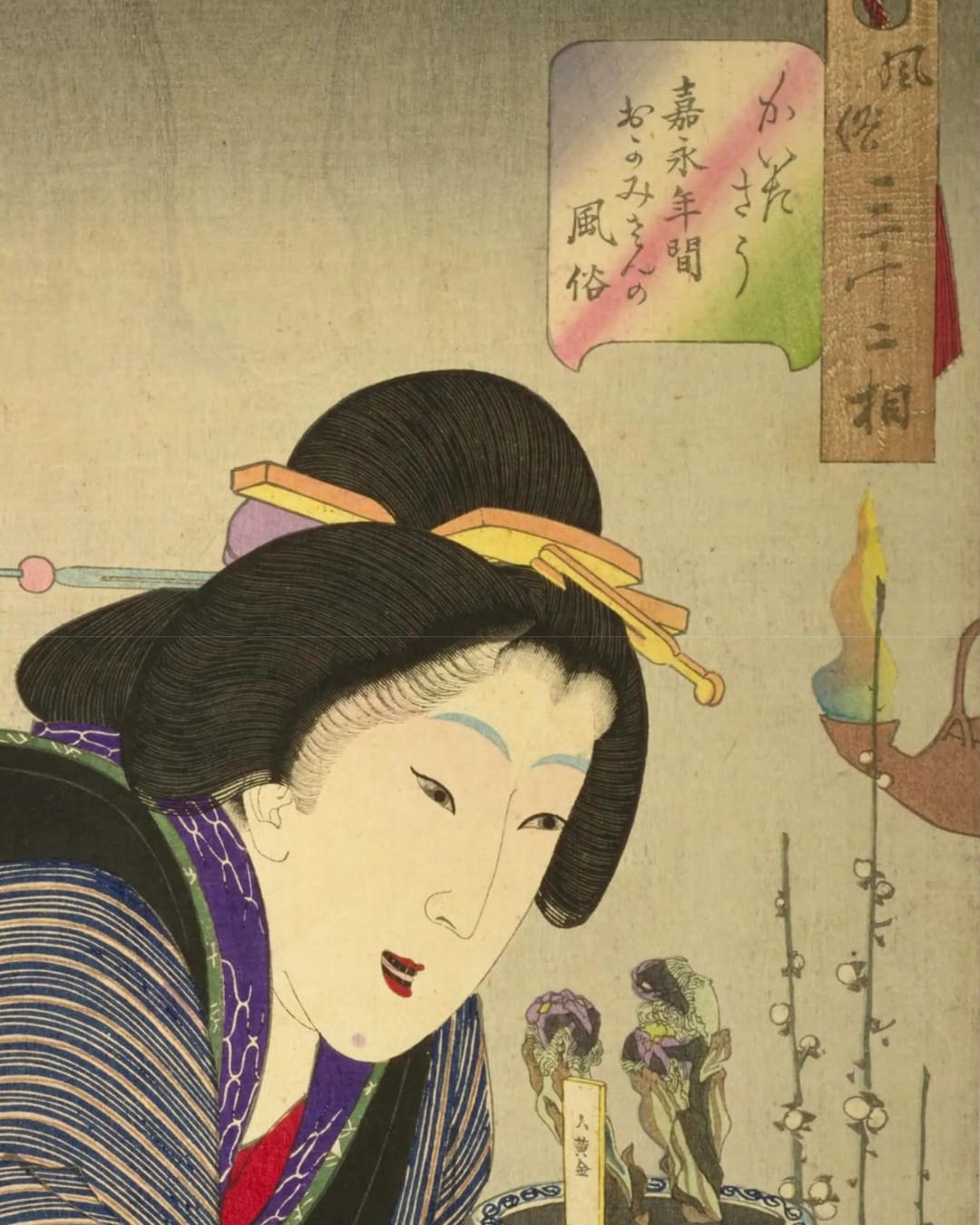
- Cover: Tsukioka Yoshitoshi, 風俗三十二相 かいたさう 嘉永年間おかみさんの風俗 (1888). National Diet Library Digital Collections, pid 1306493. dl.ndl.go.jp/pid/1306493
- Morisada’s own notes: born in Osaka in 1810, moved to Edo in 1840 and began the notebooks in 1837 (“概略,” frame 3); a note dated the 5th month of 1867 (frame 6). 守貞謾稿, table of contents and vol. 1, National Diet Library Digital Collections, pid 2592391. dl.ndl.go.jp/pid/2592391
The manuscript pages are in the public domain (National Diet Library Digital Collections). Images cropped by From the Japanese. Transcriptions and translations are our own.